
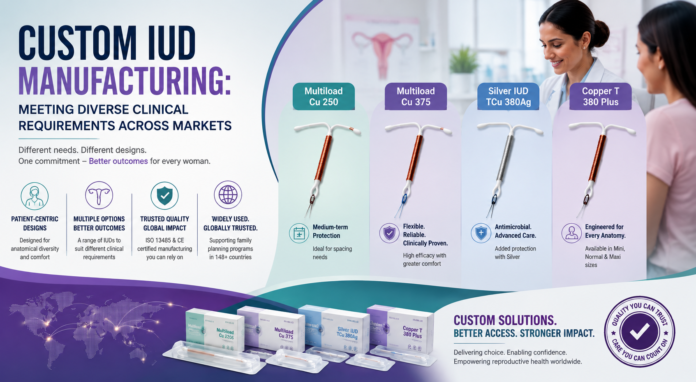

The global conversation about IUD access often treats “the IUD” as a single device. It is not. The clinical reality of intrauterine contraception involves a family of devices varying in copper surface area, frame geometry, size, copper composition, and insertion system each optimized for distinct patient populations, clinical settings, and market requirements.
The capacity to manufacture this diversity is not universal among IUD producers. Custom IUD manufacturing the ability to produce validated, certified variants beyond the standard TCu 380A is what separates a specialist manufacturer from a commodity supplier. For clinicians, procurement officers, and public health program managers, understanding that diversity is the foundation of clinical appropriateness in contraceptive care.
Why One IUD Does Not Fit All: The Clinical Case for Product Diversity
The Limitations of the Standard TCu 380A
The Copper T 380A is the most widely used copper IUD in the world and the most studied rightfully so. With up to 10 years of proven efficacy, 99% effectiveness, and extensive multi-country clinical data, it remains the global reference device for long-acting reversible contraception.
But the TCu 380A is also the largest copper IUD in common use: 32mm wide, 36mm long, with a rigid Tatum-T frame. For nulliparous women, women with smaller uterine cavities, and adolescent patients, these dimensions create real clinical challenges higher insertion failure rates, increased procedural pain, and elevated early discontinuation rates driven by cramping and bleeding.
When Device Diversity Becomes Clinically Necessary
This is where device diversity becomes not optional but essential. A procurement formulary that offers only the TCu 380A is not clinically comprehensive. It is a policy choice that disadvantages certain patient populations and ultimately increases discontinuation rates which feeds back into unmet contraceptive need.
The Multiload Family: Design Philosophy and Clinical Application
SMB Cu 250 / Multiload Copper T 250
The Multiload Cu 250 provides a lower copper surface area (250mm²) with a shorter duration of protection (typically 3–5 years). For health programs serving populations where medium-term contraception is preferred or where patients are planning pregnancy within 5 years but need reliable interim protection the Cu 250 fills a gap the TCu 380A cannot.
Clinical Applications for Cu 250
Its smaller frame makes it a clinical consideration for:
- Young or nulliparous patients in markets where provider familiarity with the multiload design is established
- Patients with smaller uterine cavities where the standard TCu 380A frame creates insertion challenges
- Programs specifically targeting inter-pregnancy spacing rather than long-duration protection
SMB Cu 375 / Copper T Multiload 375
The Multiload Cu 375 is the more widely deployed member of the multiload family internationally. With 375mm² of copper surface area wound around a flexible-arm frame with spurs that anchor against the uterine wall, it combines high contraceptive efficacy with a design that adapts to a wider range of uterine cavity sizes than the rigid Tatum-T.
Clinical Evidence for Cu 375
Multi-center trials comparing the Multiload 375 against the TCu 380A in parous women have confirmed comparable 3-year efficacy. The flexibility of the Cu 375’s side arms enables the device to remain in the highest fundal position achievable in the patient’s anatomy which matters for both contraceptive efficacy and patient comfort over a 5-year wear period.
The Silver IUD TCu 380Ag: Why Metal Composition Matters
What Silver Adds to Copper IUD Technology
The Silver IUD TCu 380Ag represents a qualitatively different product category from standard copper IUDs. Silver is integrated into the copper-bearing components for two clinically relevant reasons:
Reduced Copper Fragmentation
Copper wire on a standard IUD can fragment over time, particularly in the final years of a device’s lifespan. Silver provides structural stability that significantly reduces fragmentation. For programs managing 10-year IUD programs where device removal at the end of lifespan must be clean and complete, this matters both clinically and operationally.
Antimicrobial Properties
Silver’s well-documented antimicrobial activity provides an additional protective mechanism at the device surface. In environments where patients may have limited access to follow-up gynecological care, reducing biofilm-related complications at the device interface has real clinical value.
Size Variants: Mini, Normal, and Maxi
The Silver IUD TCu 380Ag is available in Mini, Normal, and Maxi configurations directly addressing the anatomical diversity problem that makes a single-size approach clinically suboptimal. A clinician working with a multiparous patient with a measured uterine cavity of 7.5cm selects a different configuration than one working with a nulliparous patient whose cavity measures 5.5cm. Size-specific Silver IUD variants enable that clinical precision.
The Copper T 380 Plus: Third-Generation Engineering
What the 380 Plus Series Offers
The SMB TCu 380 Plus is available in Mini, Normal, and Maxi variants again addressing the anatomical reality that “standard” is not a clinical concept that applies to uterine anatomy.
Clinical Positioning of the 380 Plus
The 380 Plus series builds on the clinical foundation of the standard TCu 380A while incorporating manufacturing refinements and size flexibility. For markets that have built clinical protocols and patient familiarity around the 380A design but need size variants to improve insertion success in patients outside the standard anatomical range, the 380 Plus series provides a transitional clinical tool without requiring a full formulary change.
What Custom IUD Manufacturing Actually Requires
Producing validated, certified variants across the Multiload, Silver IUD, and 380 Plus families under a single quality management system is not a simple scaling exercise.
Distinct Design Validation per Variant
A Multiload Cu 250 and a Silver IUD TCu 380Ag have different specifications, different raw material inputs, and different performance characteristics. Each must be designed, validated, and certified independently the quality management system does not transfer automatically from one variant to another.
Separate Post-Market Surveillance Streams
Discontinuation rates, expulsion rates, and adverse event profiles can differ between IUD models and between size variants within the same model. A manufacturer with genuine clinical accountability tracks these separately, not as an aggregate that masks model-specific performance variation.
Custom Packaging and Loading System Compatibility
A Mini Silver IUD requires a loading system designed for its dimensions. The insertion tube, flange, and solid rod specifications must be validated against the specific device geometry. Custom manufacturing means custom validation not the same loading device forced onto a variant product.
Regulatory Certification per Product
CE marking and ISO 13485 scope must cover each specific product variant. A certificate covering the TCu 380A does not automatically extend to the Silver IUD or the Multiload family. Procurement officers should verify that each product they source is named explicitly in the supplier’s certification scope.
The Market Opportunity in Product Diversity
Benefits of Single-Supplier Multi-Model Sourcing
Working with a manufacturer that offers the full range Copper T 380A, Copper T Multiload 375, Multiload Cu 250, Silver IUD TCu 380Ag in multiple sizes, and Copper T 380 Plus in Mini/Normal/Maxi enables a supply relationship that scales with clinical need.
A national health program serving a large, demographically diverse patient population needs more than one IUD model to optimize outcomes. Sourcing that diversity from a single ISO 13485 and CE-certified manufacturer reduces procurement complexity, ensures consistent quality standards across the formulary, and creates a supply relationship where clinical feedback feeds through a single post-market surveillance channel.
Conclusion
The IUD is not a single device. Clinical appropriateness in contraceptive care requires a range of options matched to patient anatomy, duration of protection needed, and clinical context. Custom IUD manufacturing from a certified, clinically experienced manufacturer is what makes that clinical precision possible at scale.
For procurement programs still operating with a single-model IUD formulary, the clinical case for expanding to include Multiload variants, Silver IUD options, and size-specific configurations is compelling. The devices exist, the clinical evidence supports their use, and the manufacturers capable of producing them to international standards are operating today. The question is whether procurement systems are designed to take advantage of that diversity or are leaving clinical outcomes on the table by treating the IUD as a commodity.